
Signed in as:
filler@godaddy.com
Women’s clubs played a vital role in shaping Hot Springs’ social, cultural, and civic life, particularly during periods when women were excluded from formal political power. Through organizations focused on education, public health, historic preservation, and community welfare, women mobilized collective influence to improve schools, libraries, parks, and social services. These clubs provided leadership opportunities and created lasting institutions that helped guide the city’s growth and identity, making them an essential part of the story of women’s impact in Hot Springs.
Key Themes: civic leadership, modernization, education
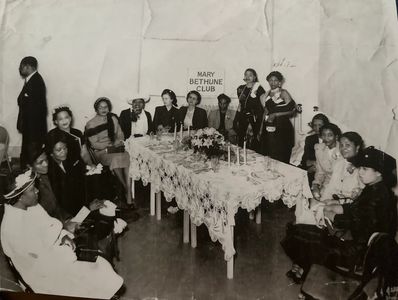
Image Credit: Courtesy of Jean Lacefield’s personal collection. Photograph of Mary Bethune Club meeting, Hot Springs Chapter.

The Lotus Club, still active today, is the oldest women’s club in Hot Springs. It was organized on October 10, 1890, by Mrs. E. W. Rector and Mrs. Prosper (Sarah) Ellsworth, with Mrs. Lillian B. Cantrell serving as its first president. From its founding, the club emphasized intellectual and cultural enrichment. Each month, twenty active members present programs focused on literary, musical, and artistic subjects, continuing a tradition of women-led cultural engagement that has endured for more than a century.
The Fortnightly Club of Hot Springs is the second oldest of the federated clubs in Hot Springs which was organized in 1895 at the Ellsworth home, known as Wildwood. It was organized by Mrs. R. B. Jaggers and Mrs. W . E. Sorrels, with Mrs. David Beitler being the first president. It became a charter member of the Arkansas Federation of Women’s Clubs in 1897, later affiliated with the General Federation of Women’s Clubs in 1908. Its primary interests included education, child study, art, women’s suffrage, and traveling libraries, reflecting the broader women’s club movement’s emphasis on community improvement and public education at the turn of the twentieth century.
Key Fortnightly Club Contributions
Source and Image Credit: Courtesy of Garland County Historical Society. Sentinel-Record (multiple articles, including Feb. 19, 1961; Feb. 6, 1977). Picture is from the Feb. 6, 1977 article.

The National Association of Colored Women’s Clubs (NACWC) was founded in 1896 with the motto “Lifting as We Climb,” uniting Black women’s clubs across the nation in service, education, and civil rights advocacy. In Hot Springs, local club women organized under the Arkansas Association of Colored Women’s Clubs, established in 1905 with the motto "Lifting as We Climb".
The Hot Springs chapter played an important role in strengthening civic leadership among Black women in Garland County. Members advanced educational opportunity, social reform, and respectability politics in an era when Black women’s leadership was often overlooked. Their work laid a foundation for generations of women leaders in Hot Springs.
Source: Courtesy of the Garland County Historical Society; Courtesy of Jean Lacefield’s personal collection. National Association of Colored Women’s Clubs Southwest Region Program (1969).
Image Credit: Courtesy of Jean Lacefield’s personal collection. National Association of Colored Women’s Clubs Southwest Region Program (1969)

Formed in the early 1960s, the Council of Hot Springs Federation of Women’s Clubs united eight to ten local women’s organizations to coordinate civic service, education, and cultural improvement. Led by the presidents of member clubs, the council planned joint projects and represented Hot Springs at the district, state, and national levels. Affiliated with the Arkansas Federation of Women’s Clubs (AFWC) and the General Federation of Women’s Clubs (GFWC), the council connected local women to broader reform networks and reinforced Hot Springs’ reputation as a center of organized women’s leadership. By 1961, Hot Springs was recognized as having more federated women’s clubs than any other city in Arkansas.
Hot Springs member clubs included the Century, Coterie, Fortnightly, Forum, Progressive, Sesame, Thinkers, Wakeusup, Demoiselle, and Criterion Clubs, many founded between 1895 and the 1930s. These long-standing civic institutions supported scholarships, libraries, schools, hospitals, conservation, arts programs, and charitable assistance, strengthening both local communities and statewide civic life.
Key Statewide Milestones of Arkansas Federation of Women’s Clubs
Source: Garland County Historical Society; Encyclopedia of Arkansas, "General Federation of Women's Clubs of Arkansas (GFWC)" ; Sentinel-Record (multiple articles, including Feb. 19, 1961; Feb. 6, 1977); General Federation of Women’s Clubs correspondence, 1957
Image Credit: General Federation of Women’s Clubs of Arkansas meeting, 1918. Photograph from the People Photograph Collection, courtesy of the Butler Center for Arkansas Studies, Central Arkansas Library System / Encyclopedia of Arkansas.
The presence of these organizations in Hot Springs reflects a strong culture of women-led civic engagement across racial, professional, and social lines. The legacy of these women lives on in the institutions they helped build, the reforms they supported, and the pathways they opened for generations of women in Garland County.
Source and Image Credit: Courtesy of the Garland County Historical Society. Image of Hot Springs Business and Professional Women’s Club Christmas float.