
Signed in as:
filler@godaddy.com
During the early to mid-1800s, as Hot Springs took shape as a permanent settlement, women played essential roles in building community, culture, and survival in a frontier environment. These are women whose labor sustained households, supported families, and created the social structures that made permanent settlement possible. Though rarely recognized in public records, they built homes, organized religious life, and managed the emotional and material work of community-making. Their contributions reveal how women’s labor shaped economic stability, social cohesion, and cultural continuity long before they held legal rights. These women transformed Hot Springs from a remote settlement into a viable, enduring community.
Key Themes: community building, domestic labor, early social networks, faith communities
Image Credit: Courtesy of the Garland County Historical Society. Original source unknown.

Sarah Perciful became the first permanent woman resident of Hot Springs in 1815. Alongside her husband John, she helped operate early rental cabins and later ran a boarding house near the springs, serving visitors drawn to the area for health and healing. Her work made her Hot Springs’ first known businesswoman and an early contributor to its tourism based economy. Although much of her work was often officially recorded under her husband’s name, her management and labor were crucial to sustaining both her family and the developing settlement.
Key Contributions
Source: Courtesy of the Garland County Historical Society
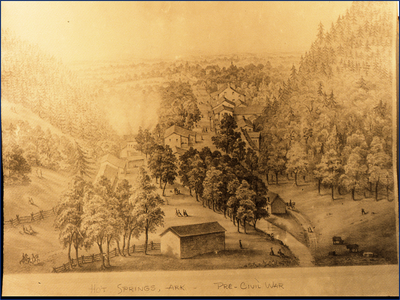
Image Credit: Image of the hot springs in 1834 - National Park Service, Hot Springs National Park archives. There are no known images of Sarah Perciful to exist. The image shown represents the time period close to which she lived.

A pioneer of remarkable resilience, Lydia Belding arrived in Hot Springs in the 1820's after enduring the loss of children during the journey west. An early settler, she played a vital role in supporting Hot Springs’ emerging identity as a health and tourism destination through the operation of boarding and lodging accommodations for visitors seeking the thermal waters. While managing household, farm, and business affairs, Lydia raised her family through disease, widowhood, and the devastation of the Civil War. She remained in Hot Springs through its most difficult periods, helping lay the economic and social foundations of the community and exemplifying endurance, leadership, and faith.
Key Contributions
Source and Image Credit: Courtesy of the Garland County Historical Society.
Sarah Gardner Hale was among the earliest settlers of Hot Springs and a central figure in the city’s early business and religious life. As early as 1831, arriving from Tennessee with her husband, John Hale, she was a working partner in Hale House, an early lodging and bathhouse operation established by 1841. Beyond her role in hospitality, Hale founded Hot Springs’ first church. She erected a log cabin at the base of West Mountain that functioned as the town’s first school during the week and as a shared worship space on Sundays for multiple denominations. This church burned during the Civil War. Right after the war, Sarah built a new church building, about where the Hale Bathhouse is today, and it’s known as First Baptist Church.
Key Contributions
Source and Image Credit: Courtesy of the Garland County Historical Society.
Fannie Henderson settled in Hot Springs with her husband, Peter, and their son Robert after filing a federal land patent in 1882 for 40 acres of what is now Hot Springs National Park. Born in Virginia in the early 1800s, Fannie and her family established a homestead and community at this site during Reconstruction, contributing to the growth of African American landownership and settlement in the city. Archaeological work at the property has provided insights into the lives and traditions of the Henderson community and others who made Hot Springs home in the late 19th and early 20th centuries.
Key Contributions
Sources: National Park Service, “Building an African American Community at Hot Springs”
Image Credit: There are no known images of Fannie Henderson to exist. The image displayed is a reproduction of the 1870 United States Federal Census, which documents Fannie Henderson by name alongside members of her family.